| Task
Group |
|
Operations |
Date |
| |
|
|
|
| |
|
|
1944 |
| |
|
|
|
| TG 21.12 |
|
Dep Norfolk, VA for
Casablanca (for ASW operations) |
07 Mar |
| |
|
Arrv Casablanca, French
Morocco (for replenishment) |
28 Mar |
| |
|
Dep Casablanca |
30 Mar |
| |
|
Rtn Norfolk (for repairs
and alterations) |
26 Apr |
| |
| Units:
USS Guadalcanal, VC-58, USS Forrest (DD-461) , USS Pillsbury (DE-133)
, USS Pope (DE-134), USS Flaherty (DE-135) , Destroyer Division
20 in USS Forrest |
| |
| Results:
U-515 sunk, 9 Apr 44, U-68 sunk 10 Apr 44 |
| |
| Click
here to proceed to the U-515 pages at the U-boat Archive website |
| |
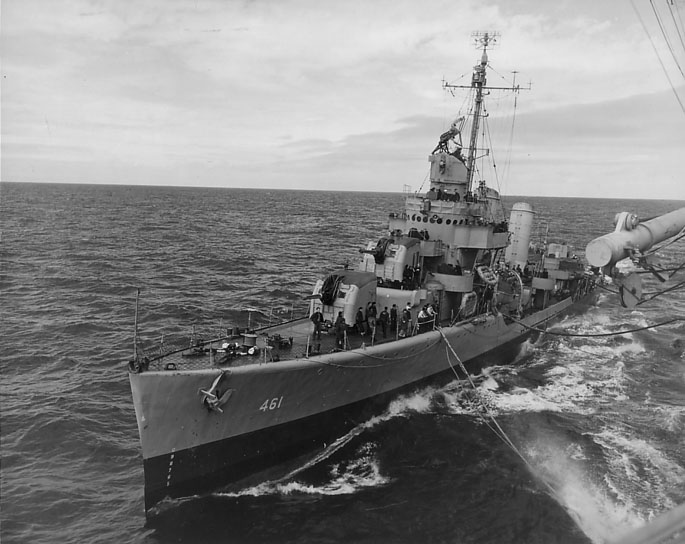 |
USS
Forrest refuels from USS Guadalcanal, 20 March 1944
|
| |
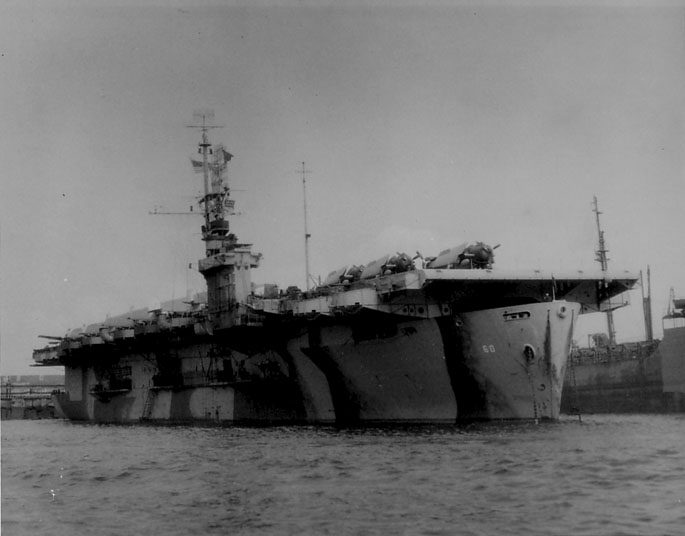 |
USS
Guadalcanal in Casablanca, French Morocco, for refueling, 30 March
1944 |
| |
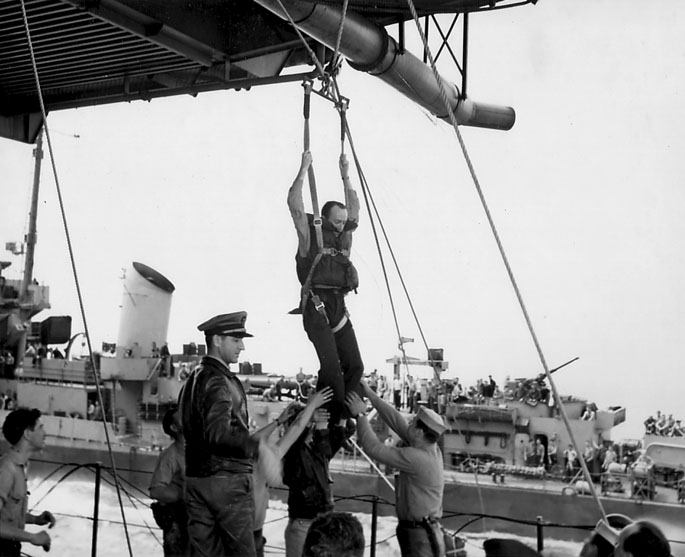 |
LTJG
W.E. Davis is transferred from USS Chatelain to USS Guadalcanal.
LTJG Davis crashed over the side attempting to land his TBF. He
and his crew were rescued by USS Chatelain and returned to the
USS Guadalcanal that afternoon, 31 March 1944. |
| |
 |
ENS
B. R. G. Daigmault's F4F, VF #7 Bu 16251, crashes into the barrier |
| |
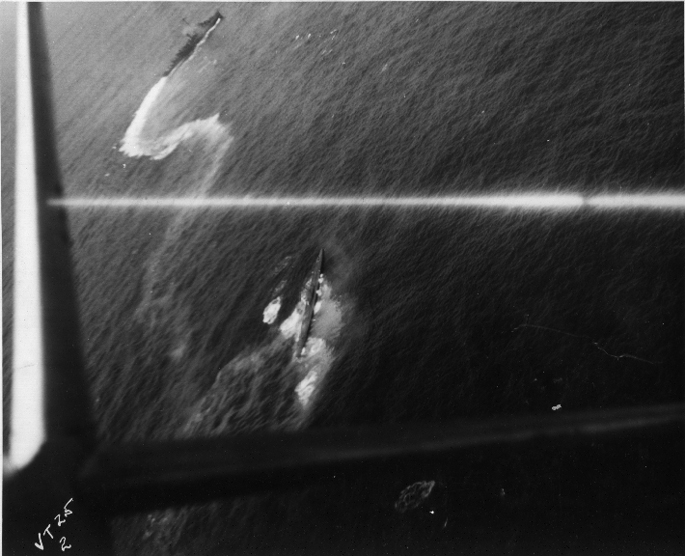 |
U-515
is forced to the surface after depth charge attacks by USS Pope,
USS Pillsbury and USS Chatelain. Chatelain maneuvers to bring
guns to bear, 9 April 1944 |
| |
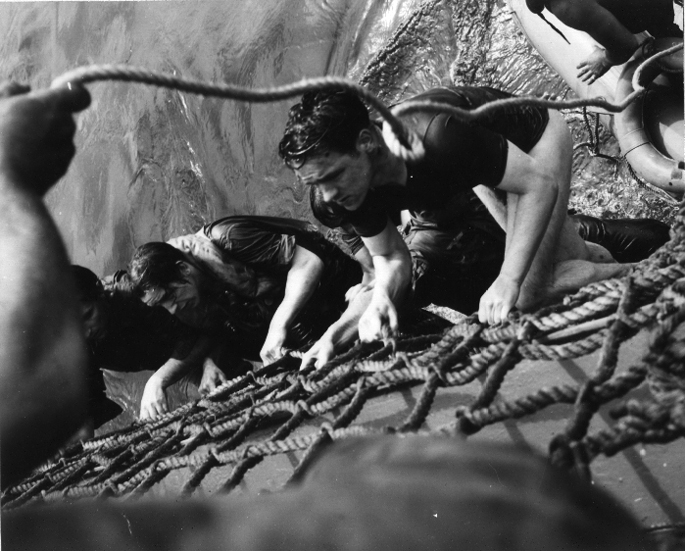 |
U-515
crewmen climb aboard USS Pope, 9 April 1944 |
| |
|
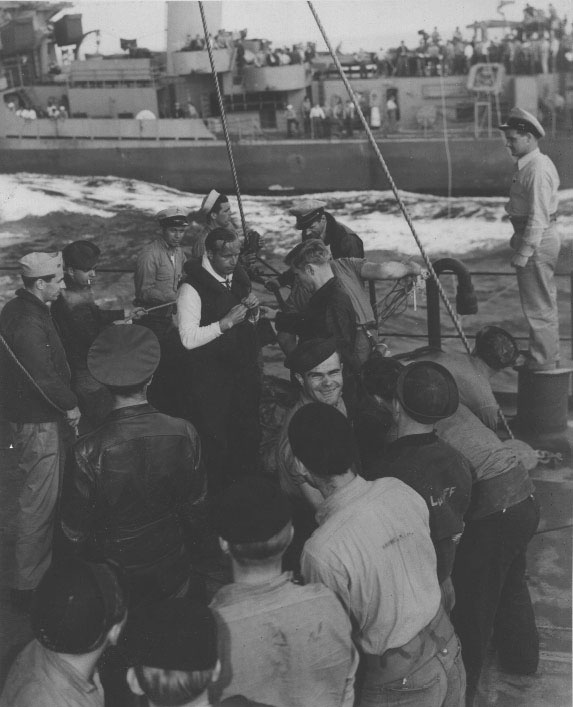
POWs
are transferred to Guadalcanal, U-515 CO Kapitänleutnant
Werner Henke, has just come aboard from USS Chatelain, 9 April
1944
|
| |
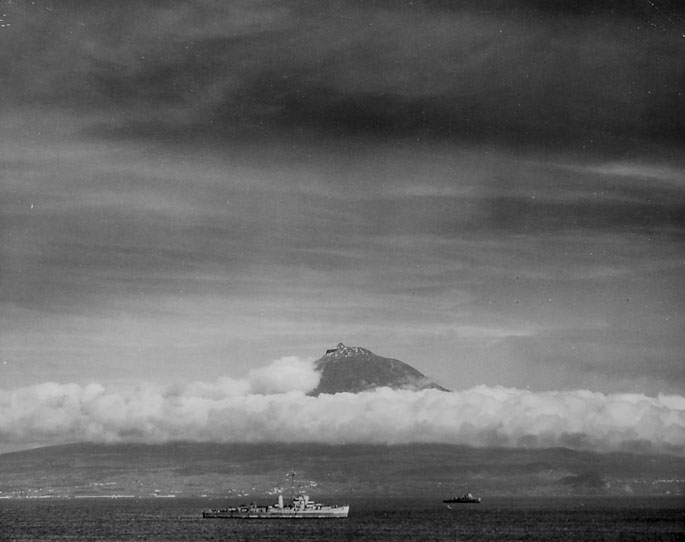 |
Mount
Pico Azores (7600 ft) as seen from USS Guadalcanal, 18 April 1944
|
| |
| Lighter-than-Air
Experiments |
U.S.S.
Guadalcanal was an escort carrier designed to handle heavier-than-air
Squadrons (HVA). Perhaps not so well known is the fact that at one
time extensive lighter-than-air (LTA) experiments were conducted
aboard ship. Here is how it happened. |
| The
Arresting Gear crew occupied a compartment located just under the
flight deck near the stern. This space, while originally built as
a repair shop, was modified on arrival in Norfolk, with the addition
of bunks and lockers and became the AG crew's living spaces as well.
Living up in the catwalk that way, we were able to get to our flight
stations in a hurry. |
| The
AG crew was made up mostly of a bunch of adventurous young squirts
about 18 or 19 years of age, barely out of high school. Orville
Tolley AMM 1/c was the AG crew’s leading petty officer. “Tolley”
had come from USS Hornet, lucky for us, and was I think, the only
one in the crew who had ever been to sea before. There was also
one old guy in the AG crew, about 24 years old, who doubled as our
"father confessor". He struggled mightily to keep us all
on the straight and narrow but his well intentioned efforts were
largely in vain, I'm afraid. |
| Anyway,
one day Tolley turned us to in the combination shop/living quarters
to make up spare deck pendents and then departed to take care of
some other matters. This operation involved hydrochloric acid used
for cleaning the cable and zinc for pouring the cable end fittings.
The happy band produced a goodly supply of spare pendants, which
were then neatly coiled and stored away in the supply locker for
future use. In the process of pouring fittings, a jug of hydrochloric
acid and some zinc chips had been left on the workbench. |
| One
of our crew recalled from his high school chemistry courses that
zinc added to hydrochloric acid will produce hydrogen gas, ..."just
like that used in the air ship "Hindenburg", he said (if
you don't recall what happened to the "Hindenburg", you
might want to look it up now; its quite pertinent to what follows).
This revelation stirred a lively debate. Some of the crew agreed
this was indeed true, but there was also a very vocal element, who,
with loud and strident voices, demanded proof. Now, any "debate"
on the Guadalcanal was usually accompanied by the laying of bets
to settle the question of who was "right" and who was
"wrong"; it was no different this time. There were wagers
as to whether hydrogen could really be produced, and if so, would
it lift anything, and if it could lift, how much weight would it
lift, and so on and so forth. It was now a "put-up or shut-up"
situation from which no self respecting U.S. Navy sailor would retreat. |
| From
this point, the "lighter-than-air" experiments began.
An empty "Clorox" bottle, highly prized for making white
hats “snowy white”, was retrieved from the garbage can
and placed on the workbench. Some acid from the jug was poured in
followed by a few chips of zinc. It was evident to even the skeptics
that something was happening. The zinc chips bounced around on the
bottom of the bottle in lively fashion, all the while emitting a
copious stream of bubbles. Those "in the know" knew this
to be hydrogen gas bubbling up through the acid but the skeptics
were not convinced, claiming it could just as well be "soda
pop" so far as they were concerned. It was suggested they might
like to taste the "soda pop" if they were so sure of themselves,
but that idea didn't go far ...after all, everyone had seen what
this stuff could do to skin and fingernails and they were not about
to risk their tonsils. |
| After
further discussion it was finally agreed that if this gas issuing
from the bottle could demonstrate a lifting capability, it would
be judged to be hydrogen. What to do? We needed a balloon. The AG
crew’s reigning bon vivant allowed as to how he had a solution
to the problem, whereupon he produced from his locker what he chose
to call a "party balloon". Without further ado, the "balloon"
was affixed to the neck of the bottle where it began to slowly inflate.
This, of course, immediately led to a whole new line of inquiry.
Just how big would it get before it burst ? More bets were laid. |
| As
we stood there gazing in fascination, the zinc bubbling merrily
away, this thing grew bigger and bigger, seemingly without limit.
After a while the Clorox bottle began showing signs of imminent
"liftoff". At this point, the “chemists” began
having visions of an extravagant liberty when we reached Norfolk
which of course would be at the expense of the "doubters".
|
| One
of the crew, who up until this moment had seemed entirely disinterested
in the "lighter-than-air" experiments, was lying in his
bunk with half closed eyes, leisurely enjoying a cigarette. Suddenly
and without a word, he decided to take part in the experiment. He
must have had it in mind that now would be a good time to test the
"Hindenburg Theory". He flipped his cigarette at the "balloon",
scoring a direct hit and achieving immediate and spectacular results.
There was a sort of hollow, muffled, ..."W-h-o-o-m-p"...
accompanied by the bright flash of the igniting hydrogen. An eerie
pale blue flame flickered across the overhead and slowly died out.
It was a spectacular display. |
| Dead
silence followed; we had all gone deaf from the over-pressure in
the closed compartment. People’s mouths were seen to be moving
but nothing was heard. As we sat recovering our senses and our hearing,
the compartment door opened followed by a head inquiring if we had
heard anything “unusual” in the past few minutes. This
turned out to be a messenger from the OD down on the hanger deck
who had heard the experiment and decided to investigate. To the
folks on the hanger deck, the sound was heard as a dull thud that
came from somewhere under the flight deck aft on the starboard side.
We were pinpointed pretty good. |
| Well
of course we hadn’t really heard anything “unusual”
– for it is always to be expected that hydrogen will make
a big…“thud”… when it burns off. However,
we didn’t think the messenger would understand the subtleties
of this explanation so he departed with our advice he look elsewhere
for the source of the mysterious noise. After all, everything was
just hunky-dory in the AG shack. |
| Bets
were collected and when the ship arrived back in port some of us
had one of those unforgettable Norfolk liberties. But it was also
decided we knew all we needed to know about hydrogen, maybe even
a little more than was necessary, and by mutual agreement the "lighter-than-air"
experiments were concluded for good. |
| ...Donald
M. Baker ABM1/c, USS Guadalcanal |
| |
|
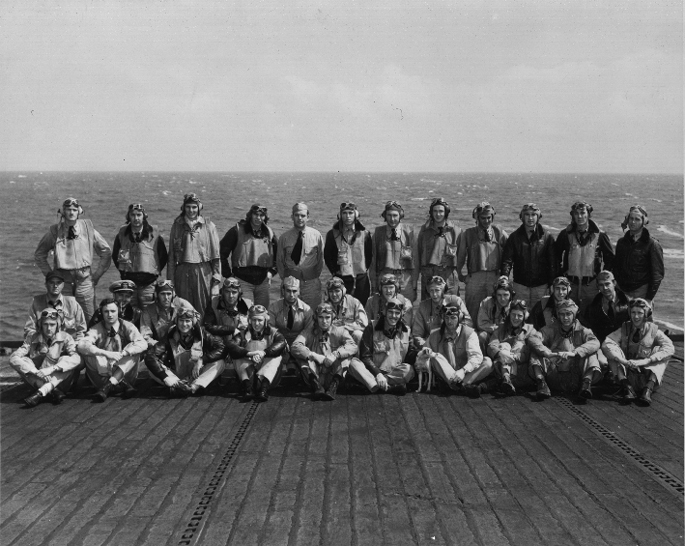
VC-58
VT pilots on the flight deck of the USS Guadalcanal, 15 April
1944 |
| |
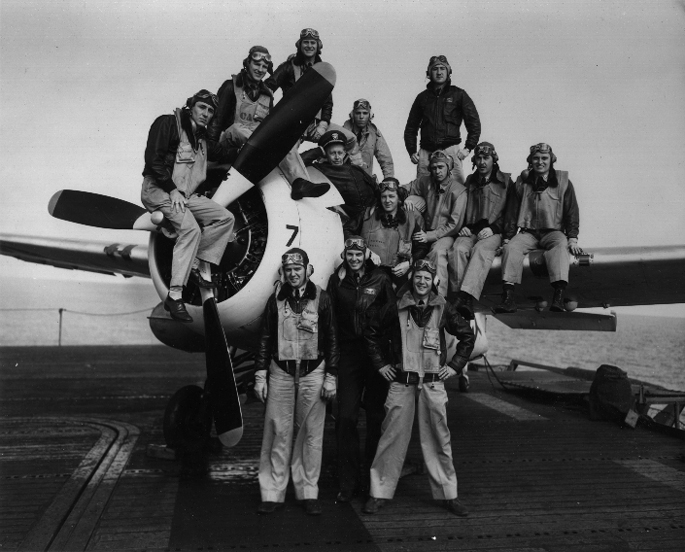 |
VC-58
VF pilots on the flight deck of the USS Guadalcanal, 15 April
1944 |
| |
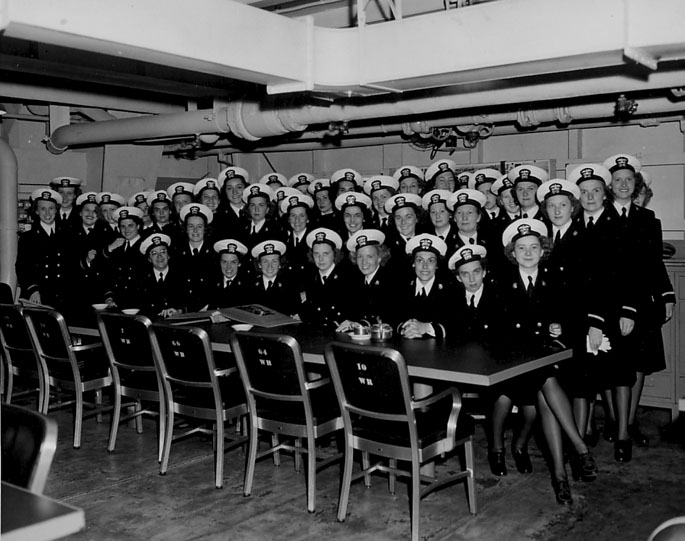 |
| Visiting
nurses in the Wardroom of the USS Guadalcanal at Norfolk Navy
Yard, 5 May 1944 |